Mauled
The day was just another ordinary fall day, living in Mansfield, Ohio. I was 4 ½, my brother was seven, and it was a warm September afternoon. My mom was gardening. From what I’ve been told, my brother and I were playing around and probably being annoying, like young kids can be, so my mom suggested we go play with the dog next door.
Our neighbors had a beautiful Irish Setter named Peppy. Peppy had a doghouse in their backyard and was often chained up, going into her doghouse for respite. While we were annoying my mom, I must have been annoying my brother too, because he told us to take turns.
Interestingly, that is one of the only things he remembers from that day—suggesting we take turns.
I was so delighted to be included in the game. I remember excitedly approaching Peppy, squeezing a hug around her neck, most definitely gripping too tight as an enthusiastic dog-lover 4-year old would do, and saying, “I love you, Peppy!” Giving her extra love.
I don’t remember the first bite. My body didn’t allow me to remember what the bites felt like. What I understand now is that she didn’t just nip at me—she tore into my face with force. It was a significant, traumatic injury.
And yet… I don’t remember pain. My body had already gone into shock. It’s like everything went quiet and distant, as if I wasn’t fully there for what was happening.
She first bit the right side of my face—I think in one bite. Fortunately, it wasn’t my eye or my jugular vein, but she took a large chunk out. She then moved forward and bit my left arm.
I must have been screaming because my mother heard me. From her account, she found me lying on the ground, and the dog had quietly walked back into her cage. My mom swooped me up in her arms and carried me across the street to the neighbor’s house, my brother following behind.
What stayed with my brother wasn’t the attack itself, but what came after. He remembers standing there, watching the neighbor’s husband hose my blood off of their front porch and walkway.
It’s always struck me how differently our bodies and minds hold onto trauma—what one person remembers, and what another cannot.
Fortunately, the neighbor was a nurse and knew what to do—applying pressure with towels to my face. They immediately got me into their car and drove me to the nearest hospital.
What I do remember is being in my mother’s arms in the car. I must have been scared, because I was asking questions like: “Am I going to die? Am I going to be put in the ground in a grave? Am I going to see God?”
My mother, while she must have been completely overwhelmed and terrified, was there to comfort and reassure me that I was going to be okay.
The next thing I remember is being in the emergency room. They had to cut off my shirt to prepare me for surgery.
I was wearing this navy blue, half zip-up shirt—the kind that was really popular in the 1970s. It was a hand-me-down from one of my best friends, and it was the first time I had worn it. I remember feeling so excited about it… I felt so cute.
And I remember feeling genuinely sad when they told me they had to cut it off of me. That it was going to be ruined.
It’s always struck me how that was one of the things my mind held onto in that moment.
In the corner of the room was my mother, probably around 35 years old, covered in my blood and crying. I remember vividly saying to her, “Mommy, don’t cry. Everything will be okay.”
When I think about it now—my brother remembers the blood. I remember the shirt… and my mom crying.
That’s the last thing I remember before they whisked me off to surgery. I received over 150 stitches to my face, and later, they took skin from my upper left thigh for a graft during plastic surgery.
I don’t remember feeling fear. Later in life, as a trauma therapist, I came to understand that my body, in order to survive, had to leave itself. I was in shock, close to death, but I did not have a near-death experience.
As I grew up, I wasn’t afraid of dogs. But what stayed with me was something deeper—a quiet awareness that something bad could happen, that you could die. At some level, I knew I had escaped death.
For much of my life, I rationalized that nothing bad would happen to me because that already had. I had my scare.
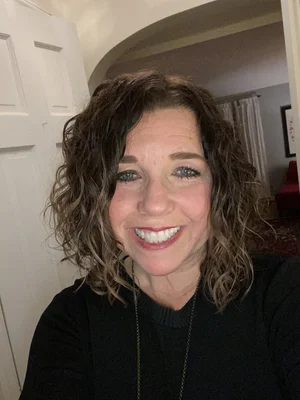
The incident left a large scar on my face. At 13, going into eighth grade, I chose to have plastic surgery. The scar was transformed from a thick, gnarly mark the size of a silver dollar into a long, thin line that trails from behind my ear to underneath my chin.
Today, it’s so natural-looking that you barely notice it. That was my biggest fear growing up—that I would always be marked by it. Now I can go places without makeup and not even think about it.
Of course, I am 57… lol.
But that incident absolutely lives in my nervous system. Underneath, there has always been a subtle sense of being on guard—my body resting more easily in a sympathetic state.
Over the years, I’ve been able to look at the experience and find gifts within it. I’ll talk more about this in future blogs around soul work and lifetime intentions, but according to my astrological chart, one of my goals in this lifetime is financial independence.
That dog bite led to a financial settlement that supported me later in life—helping pay for college, my first car, and a down payment on our first house. It eased things during a time when my parents struggled financially.
But the dog attack was just one piece of a much larger picture.
I grew up with severe asthma and allergies. My first asthma attack happened at age one, and I was hospitalized. Throughout my childhood, I was in and out of hospitals with asthma, pneumonia, and breathing issues.
Thankfully, as an adult, it is well managed. But growing up, I have many memories of not being able to breathe and being afraid I wouldn’t get help—having to calm myself in order not to make things worse.
I learned very early how to shut down my body and contain things. That’s a beautiful survival skill—but when you want to be present, it takes work to unwind.
With asthma came constant preparation. If I was going anywhere, I had to have my inhaler. Looking back, I probably had some ADHD tendencies, because I would forget it—and that would sometimes get me into trouble.
It makes sense now why my nervous system craves structure. I like to have a plan. I don’t like surprises. I need to know what’s going on.
Like many people who have experienced trauma and learned to dissociate, I could tell the story of my dog bite without any emotion or internal reaction.
That changed in graduate school.
I became friends with an incredible human—an energy healer. I had just started learning about chakras and energy. One day, she was working on me and told me that every time I lay on her table, she felt a constant buzzing—like static—from my body.
She said she was often drawn to my sacral area, which can indicate childhood trauma. She asked if I had experienced any.
At first, I didn’t think so. Then she clarified—it didn’t have to be sexual. I said, “Well… I was mauled by a dog when I was four.”
We laughed. She asked if I wanted to work on it that day. I said yes.
As she continued her work, guiding me back into the memory, something shifted. Looking back now as an EMDR therapist, I can see we were reprocessing the trauma through parts work and ego states.
But in that moment, lying on the table, I began to sob—uncontrollably. Something I had never allowed myself to do.
As she guided me toward a light, working around my crown and third eye, I felt a complete release. At the exact moment I felt it, she exhaled deeply.
I asked her why. She said she saw and felt the energy release. She shared that it was clear I had left my body during the attack, and that we were bringing that part of me back—protecting and nurturing that child at the moment of the incident.
My mother was there afterward—but not during the actual attack.
It made so much sense to me, even before I had formally studied parts work or self-energy.
Later that evening, I developed a strange, oozing blister on the right side of my hand—the same side of my body where I had released the trauma. The timing felt… meaningful.
I want to share one more piece about how trauma lives in the body.
In my late 20s, I went to a work pool party. The host had a chocolate lab. At some point, the dog got stung by a bee on his snout. He yelped and ran to the back door.
I let him in and called out to the owner, Tim, telling him what happened. He asked where the dog had been stung. I raised my hand and pointed above my head.
That gesture triggered the dog.
He lunged, barked in my face, and nipped my arm—breaking the skin, but not deeply.
At the time, I brushed it off. But later, I began to cry… and I cried for about a week straight.
At 28, I realized that maybe the original trauma had stayed with me more than I thought.
Now, I can smile about it—but of course my body remembered.
Trauma is not the event itself. Trauma is what happens in the body when we cannot process the experience. Those unprocessed sensations stay stored, waiting to be released—sometimes through emotional responses, sometimes through physical symptoms.
One way my body coped was by shutting down.
Taking my therapist hat off for a moment and returning to spirituality—this experience shaped my early beliefs about death and dying.
As a child, and into young adulthood, I carried a fear of death. At the same time, I found comfort in God. I was raised Christian, attending a small Christian elementary school.
I learned about death—but also about sin, fear, and consequence. And while the mauling and respiratory issues shaped my early fear of death, what I was taught about it would shape everything that came next.
It created a foundation rooted more in fear than in acceptance.
But looking back now, I can see how much of this story begins and ends with my mom.
Her arms were the place I returned to after leaving my body… and in so many ways, she has continued to guide me back to myself ever since.
I didn’t know it then, but that moment stayed with me—in my body, in my beliefs, and in the quiet ways I learned to protect myself.
And maybe, in some way, it also became the beginning of my path back to understanding what it means to feel safe… in my body, in this life, and beyond it.
Addendum
I originally thought about rewriting parts of this post after talking with my brother recently and learning more details about the event. But ultimately, I decided to keep the original story as I remembered it and as it had been told to me throughout my life.
When I shared this post with my brother to make sure he felt comfortable with me telling a story that belonged to both of us, he gave me an entirely different perspective of the event based on his own experience. He remembers far more than I do.
He reminded me that he had actually stayed home from school that day “sick.” Maybe he just wanted a day at home with Mom or needed a break from school. My mother was gardening, and the two of us were helping her—probably pulling weeds.
He remembers it being a very hot day and said the dog next door was barking incessantly and bothering all of us. My mom suggested that we go check on the dog and maybe play with her for a bit.
My brother wanted to stay back and finish what he was doing because he is very disciplined and focused… lol, even to this day. He told me, “Why don’t you go first, Susan, and I’ll come join you.”
Then he remembered something else. He thought maybe the dog was thirsty. He told me to go ahead to check on Peppy while he brought water.
The next thing he remembers is hearing me scream.
He said he found me in the dog’s mouth. By that point, the dog was likely tearing into my left arm, and he jumped in to try to save me—pulling me away from the dog. He remembers the dog lunging toward him, grabbing his foot, and pulling the shoe right off of him. He lost that shoe.
He remembers seeing a lot of blood. He remembers being scared—but also immediately going into protective mode.
What stayed with him the most, though, was being left behind when I went to the hospital. He said he felt safe himself, but he wasn’t sure if I was safe, and that terrified him.
To this day, he still doesn’t like Irish Setters or barking dogs. But he isn’t afraid of dogs. His experience of the event was so different from mine in many ways.
Hearing his version gave me a completely new perspective—and an even deeper love for my hero, my brother.
Who, by the way, a year later decided he had finally had enough of the boys on the school bus relentlessly making fun of my scar and calling me Frankenstein every day.
Apparently, he got brass knuckles from a neighborhood kid, intentionally sat in front of the boys on the bus, and waited. The moment they started making fun of me again, he turned around and punched one of them dead center in the face.
Needless to say, we both got kicked off the bus and had to walk home and explain to my mother what had happened.
Ironically, I barely remember that incident at all. But my brother remembers it vividly.
Looking back now, I realize he has always been protecting me in the ways he knew how. In so many ways, he became my first guardian… my built-in protector long before either of us understood the weight of what we had both lived through together.